 Free Same Day Delivery Islandwide | Order by 5PM for Today’s Delivery | 800+ 5-Star Reviews
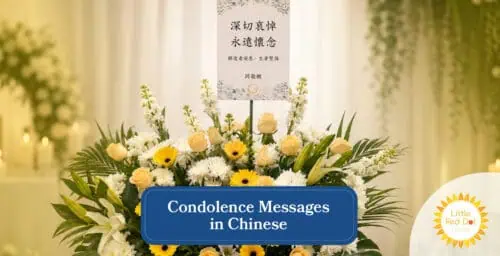
Condolence Messages in Chinese
When someone experiences the loss of a loved one, finding the right words can feel incredibly difficult.
Many people worry about saying too much, saying too little, or unintentionally choosing words that may not feel appropriate during such a sensitive time. During moments of grief, however, it is often the simplest and most sincere expressions of sympathy that bring the greatest comfort.
In Singapore, where Chinese funeral traditions remain an important part of many families’ customs, condolence messages are commonly included with funeral flowers, condolence wreaths, sympathy cards, and floral stands. Whether you are attending a wake, sending a funeral flower arrangement, or expressing sympathy from afar, a thoughtful message helps personalise your gesture.
At Little Red Dot Florist, we understand the importance of expressing condolences respectfully across different cultures and traditions. This guide introduces commonly used Chinese condolence messages, their meanings, and when they are most appropriate.
Why Chinese Condolence Messages Matter
A condolence message is more than a few written words.
It acknowledges a family’s loss, expresses sympathy, and offers emotional support during one of life’s most difficult moments. While funeral flowers create a visual tribute of remembrance and respect, the accompanying message adds a personal expression of care.
In Chinese culture, condolence messages are generally brief, respectful, and understated. Rather than using long emotional paragraphs, families often appreciate simple words that convey sincerity and compassion.
This is especially true for messages displayed on condolence wreath ribbons or attached to funeral flower stands, where space is naturally limited.
Common Chinese Condolence Messages
The following expressions are among the most commonly used during Chinese funerals in Singapore.
节哀顺变
Jié āi shùn biàn
“Please restrain your grief and take care of yourself.”
This is perhaps the most widely used Chinese condolence expression. Rather than asking someone not to grieve, it gently encourages them to take care of themselves while accepting support during a difficult period.
深切哀悼
Shēn qiè āi dào
“Deepest condolences.”
This short phrase is commonly seen on condolence wreaths and funeral flower stands because it is respectful, formal, and suitable for almost every relationship.
谨致哀悼
Jǐn zhì āi dào
“With deepest sympathy.”
This expression is often used in more formal settings, including corporate condolences and messages sent on behalf of organisations.
一路走好
Yí lù zǒu hǎo
“May you have a peaceful final journey.”
This phrase is directed toward the deceased rather than the family. It expresses a respectful farewell and wishes the departed peace on their final journey.
愿逝者安息
Yuàn shì zhě ān xī
“May the departed rest in peace.”
This message is commonly used in sympathy cards and condolence flowers. It offers a peaceful blessing while remaining simple and respectful.
沉痛哀悼
Chén tòng āi dào
“Heartfelt condolences.”
This phrase expresses deep sorrow over the loss of the deceased. It is suitable for condolence wreaths, sympathy cards, and formal funeral flower messages.
永远怀念
Yǒng yuǎn huái niàn
“Forever remembered.”
This message expresses lasting remembrance of the departed. It is especially appropriate when the sender knew the deceased personally or wants to honour their memory with warmth and respect.
安息主怀
Ān xī zhǔ huái
“Rest peacefully in the Lord’s embrace.”
This phrase is commonly used for Christian Chinese funerals. It offers a faith-based message of peace and comfort, making it suitable when the deceased or family is Christian.
音容宛在
Yīn róng wǎn zài
“Your voice and presence remain with us.”
This traditional expression reflects the idea that the memory of the deceased remains vivid. It is a more poetic phrase often used when remembering someone with deep respect.
福寿全归
Fú shòu quán guī
“A life of blessings and completeness.”
This phrase is often used when the deceased lived to an advanced age. It acknowledges a full life and is generally more appropriate for elderly loved ones rather than sudden or young passing.
Chinese Condolence Messages for Funeral Flower Stands
Because condolence wreath ribbons have limited space, shorter messages are usually preferred.
Some commonly used examples include:
深切哀悼
Deepest Condolences.
谨致哀悼
With Deepest Sympathy.
愿逝者安息
May the departed rest in peace.
永远怀念
Forever Remembered.
音容宛在
“Forever remembered through cherished memories.”
沉痛哀悼
Heartfelt condolences.
一路走好
May the departed have a peaceful final journey.
节哀顺变
Please accept our condolences and take care.
福寿全归
A life of blessings and completeness.
德范长存
Your kindness and virtues will be remembered.
These expressions are widely accepted for condolence flower stands and funeral wreaths throughout Singapore. For more guidance on choosing the right words based on your relationship with the deceased or their family, read our guide on “What to Write on a Condolence Wreath: Sample Messages by Relationship“.
Messages for Friends and Family
If you know the grieving family personally, a slightly warmer message may feel appropriate.
愿您和家人在这段困难时期得到平安与安慰。
“May you and your family find peace and comfort during this difficult time.”
我们与你和你的家人同在。
“Our thoughts are with you and your family.”
请接受我们最诚挚的慰问。
“Please accept our heartfelt condolences.”
在这悲伤的时刻,愿您和家人感受到身边人的关怀与支持。
“During this sorrowful time, may you and your family feel the care and support of those around you.”
愿逝者安息,也愿家属节哀保重。
“May the departed rest in peace, and may the family take care during this time of grief.”
愿美好的回忆陪伴您和家人度过这段艰难的日子。
“May cherished memories help you and your family through this difficult time.”
我们深感哀痛,愿您和家人在悲伤中得到安慰。
“We are deeply saddened and hope you and your family find comfort in your grief.”
愿您在亲友的陪伴中得到力量与平安。
“May you find strength and peace in the company of family and friends.”
逝者已矣,愿留下的爱与回忆永远温暖您和家人的心。
“Though the departed has passed on, may their love and memories continue to warm your hearts.”
在这难过的时刻,请知道我们一直惦记着您和您的家人。
“During this painful time, please know that you and your family are in our thoughts.”
愿时间慢慢抚慰伤痛,愿逝者的爱永远留在心中。
“May time gently ease the sorrow, and may the love of the departed remain forever in your heart.”
These messages acknowledge both the family’s grief and your personal support. For more heartfelt wording in English, you can also read our guide on writing “Condolence Messages for a Friend” to find thoughtful examples for offering comfort and sympathy.
Professional Condolence Messages
For colleagues, clients, or business associates, formal expressions are generally preferred.
Examples include:
谨代表全体同仁致以最深切的慰问。
“On behalf of all our colleagues, please accept our deepest condolences.”
谨致最诚挚的哀悼。
“With our sincerest sympathy.”
谨向您和您的家人致以深切慰问。
“Please accept our deepest condolences to you and your family.”
谨代表公司全体成员,向您致以诚挚哀悼。
“On behalf of everyone at the company, we extend our sincere condolences.”
在此悲痛时刻,谨向您和家属表达最深切的慰问。
“During this time of sorrow, we extend our deepest sympathy to you and your family.”
These messages are commonly attached to corporate condolence wreaths and funeral flower stands sent by businesses in Singapore. For workplace-appropriate wording, you can also read our guide on “Condolence Messages for a Colleague” for respectful examples to express sympathy professionally.
Choosing the Right Message
The most appropriate condolence message often depends on your relationship with the grieving family.
For close friends or relatives, a warmer and more personal message may feel natural. For colleagues or professional relationships, shorter and more formal wording is usually preferred.
If you are uncertain, choosing a traditional phrase such as 深切哀悼 or 谨致哀悼 is almost always appropriate.
Simplicity is often viewed as a sign of respect within Chinese funeral traditions.
The Role of Funeral Flowers in Chinese Funerals
Funeral flowers remain an important part of many Chinese funerals in Singapore.
Standing condolence wreaths are commonly displayed alongside the wake, offering visible expressions of sympathy from family members, friends, companies, and organisations.
White flowers are traditionally chosen because they symbolise mourning, peace, sincerity, and remembrance. White chrysanthemums are among the most common Chinese funeral flowers, often accompanied by lilies, orchids, carnations, and white roses.
The condolence message attached to the arrangement completes the gesture, adding a personal expression of support while honouring the memory of the deceased. You can browse Little Red Dot Florist’s Funeral Flowers for Singapore Same-Day Delivery to choose a respectful condolence wreath or flower stand for a Chinese funeral.
A Few Thoughtful Words Can Mean So Much
Many people worry about finding the “perfect” condolence message.
In reality, grieving families rarely remember every word that was written. What they remember is the kindness behind the gesture.
A simple phrase expressing sympathy, combined with a thoughtful funeral flower arrangement, reminds families that they are surrounded by people who care during one of life’s most difficult moments.
At Little Red Dot Florist, we believe that funeral flowers are about more than appearance. They are quiet expressions of remembrance, respect, and compassion. Whether you are sending a condolence wreath, sympathy flowers, or a funeral flower stand, choosing sincere words can make your gesture even more meaningful.
Because during times of loss, even a few gentle words can bring lasting comfort.
What is the safest Chinese condolence message to use?
The safest Chinese condolence message is 深切哀悼, which means “deepest condolences.” It is short, respectful, and suitable for most Chinese funerals in Singapore, whether you are sending flowers as a friend, relative, colleague, or company.
Is 节哀顺变 appropriate for funeral flowers?
Yes, 节哀顺变 is appropriate for sympathy cards and personal condolence messages. However, for funeral flower stands and wreath ribbons, shorter and more formal phrases such as 深切哀悼, 谨致哀悼, or 愿逝者安息 are often preferred because they fit better on the arrangement.
Should I write the condolence message in Chinese or English?
Both Chinese and English condolence messages are acceptable in Singapore. If the bereaved family is Chinese-speaking, a Chinese message can feel more personal and culturally appropriate. If you are unsure, a simple English message such as “With deepest sympathy” is still respectful.
Can companies use Chinese condolence messages for funeral wreaths?
Yes, companies can use Chinese condolence messages when sending funeral wreaths or condolence stands. Formal phrases such as 谨致哀悼 or 深切哀悼 are suitable for corporate arrangements, especially when the flowers are sent on behalf of a team, department, or organisation.
What should I avoid writing in a Chinese condolence message?
Avoid overly casual wording, jokes, long emotional messages, or phrases that sound too celebratory. It is also best to avoid bright, festive language and strong religious wording unless you know the family’s beliefs. A short, sincere message is usually the most appropriate choice.